The Photograph That Waited For Me
I cannot explain why I noticed her now, after all these years. I only know that I did.
And I find myself wondering whether we ever truly see everything in the moments we live—or whether some things reveal themselves only when the time is right.
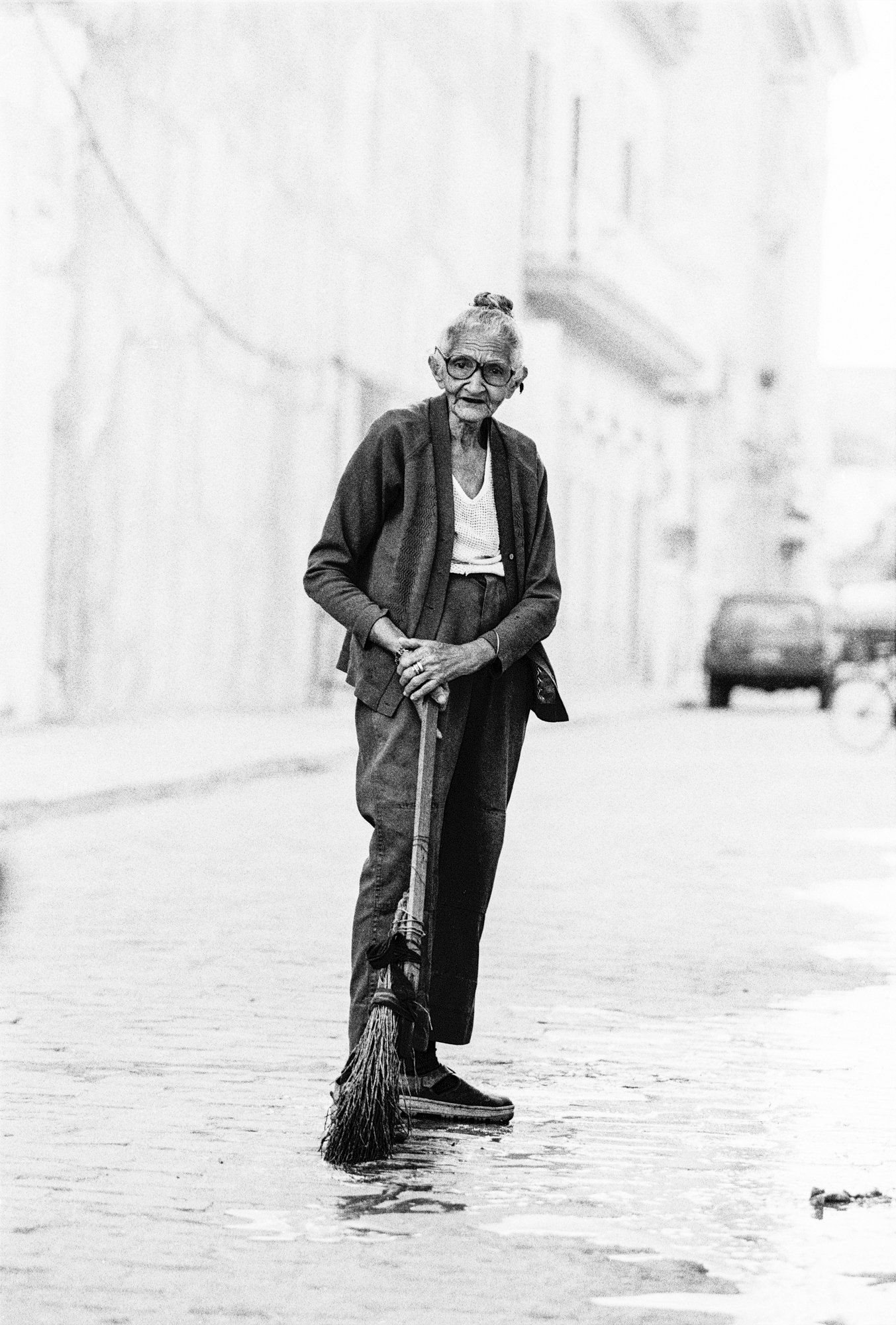
A woman and her broom.
She was simply a woman, standing in the aftermath of rain, holding a broom she had made from what was available, carrying herself with a dignity that needed no explanation.

Perseverancia
As for the people...
I no longer like calling them resilient.
Resilience is a compliment the comfortable give to those with no alternative.

The Hammock
I left with another photograph. I left with rolls of exposed film. It would take years to realize that these rolls were not the only thing being developed.

So He Stands
What matters is presence, the fact of having endured another day, of having held a position, however small, against the erosion of time.

Though The Day Has Barely Begun
He does not look at us with expectation. That, perhaps, is what unsettles most.

Stillness Is Everywhere
And that stillness is everywhere. It gathers in the shoulders of those leaning against columns, in the absence of smiles, in the quiet agreement to wait without expectation.

Up there, everything changed!
She held my gaze, then made a simple gesture~fingers rubbing together, the universal language. I nodded. A couple of dollars. An exchange. An invitation!

A Simple Act Becomes A Gift
A simple act becomes a gift. A quiet witness becomes part of the moment.

Beginning To Disappear
One has lost her head to time, the other to movement, and between them the distinction between permanence and presence begins to collapse.

To Echo Cuba Itself
In this way, it begins to echo Cuba itself, held between a past that still glows and a future that has yet to fully reveal itself.

No Hay ~
I remember standing there, taking that in. The simplicity of it. No explanation, no apology. Just absence, written plainly, like it’s the normal. Like maybe tomorrow it’ll be there… or maybe not.

¿El último? (The Last One?)
The two women here seem almost connected, even if they don’t know each other. The way they hold their hands, the way they look ahead, it’s the same feeling, the same quiet patience.

La Maravilla ~ The Wonder
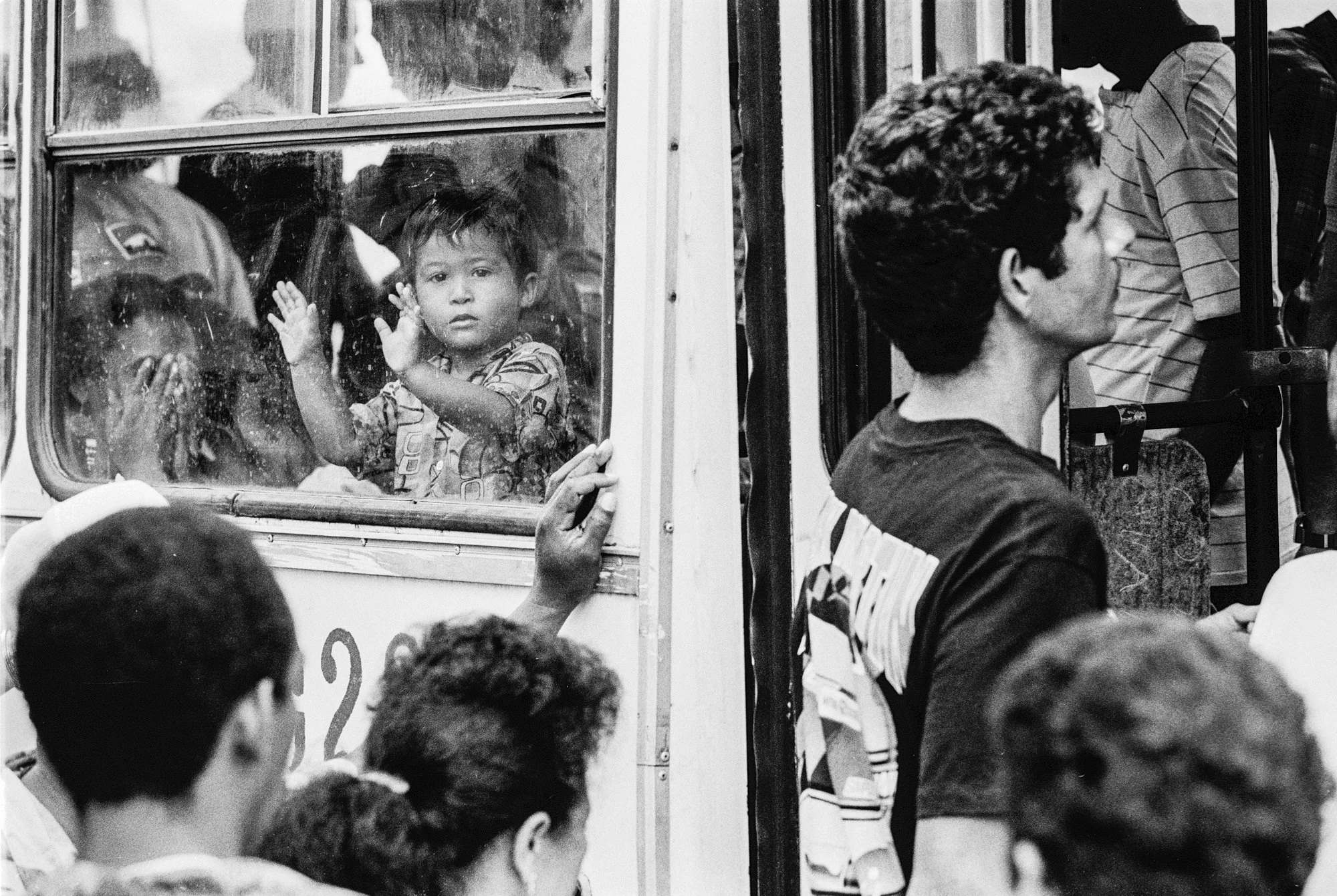
She appears almost as an afterthought ~ a woman framed by a window, a child gathered into her arms. Or perhaps I am the afterthought, arriving late to something already complete. When I raise the camera, she does not retreat. Instead, she turns inward for a moment, her hand rising to her hair, not in vanity but in a kind of readiness, as if she understands that to be seen is also to compose oneself. Not for me, but with me.

Bus-Havana, Cuba
In a place like Havana, so often photographed, you begin to wonder what remains unseen, what slips past the careful compositions and cliched narratives. For decades, thousands of photographers have arrived with intention, with structure, with the quiet certainty of capturing something perceived as essential.
And yet, here, something is different.

Chiclet! Chiclet!
In the early years of my wanderings through Cuba, I often found myself simply drifting through the streets, letting my spirit guide decide where I might end up. The vibe carried its familiar mixture of wonder as each corner turned was another surprise; the rhythm of life unfolded with an expectation of the unexpected. It was during one such wandering that I came upon a group of boys in the midst of a game that seemed to belong to every childhood everywhere, some version of war, or perhaps cops and robbers. The exact rules were invisible, but the urgency was clear. I recognized it instantly; I had played such games myself once, in another time.
They noticed me almost at once.

No Es Facil
In the humid, twilight of Cuba, a country that has become a masterpiece of slow-motion disappearance. One realizes that to be Cuban is to live within a beautiful, heartbreaking paradox. Sitting on a crumbling seawall along the Malecón, watching the spray of the ocean that leap like a ghost over the sea wall, and you will hear the familiar sigh of the Cubans: “No es fácil.”

Why Black and White?
It was a modest house, tucked away in a quiet barrio—my Abuela’s sister’s home, where our voices had carried softly across tiled floors and the afternoon heat pressed with intensity against the shutters. We had just said our goodbyes when I slid into the front seat of the car. The streets pulsed with their own unruly rhythm. The buildings, though faded and crumbling at the edges, seemed to exhale memory with every crack in their facades. But it was the people who gave Havana its heartbeat. They didn’t just inhabit the streets; they charged through them, each one carving a path with quiet purpose, stories in their eyes—but something inside me had shifted.

No Nos Olvides ~ Don’t Forget Us ~ Ofelia
We are tales wrapped in tobacco leaves,
Whispers swaying in mango trees.
The hush from Havana still tells the tale—
Of love, of loss, of dreams that never sail.

Like stepping onto a roller coaster, only in the dark!
The day arrived and I flew to Nassau. I moved through the airport, found the Cubana Airlines desk, bought my ticket, and with a slip of paper that served as my visa, I waited. I was already feeling like I was going back in time. Boarding the Tupolev, an old Russian aircraft, was an adventure in itself as it was stairs waiting to climb to board. Walking across the tarmac, I saw the wheels—bald, the metal tread exposed. The engines roared to life, and soon white smoke drifted from the floor. I learned it was just the air conditioning. On future flights, I learned which passengers were first timers as a look of panic appeared on their faces as that smoke appeared.