Beginning To Disappear
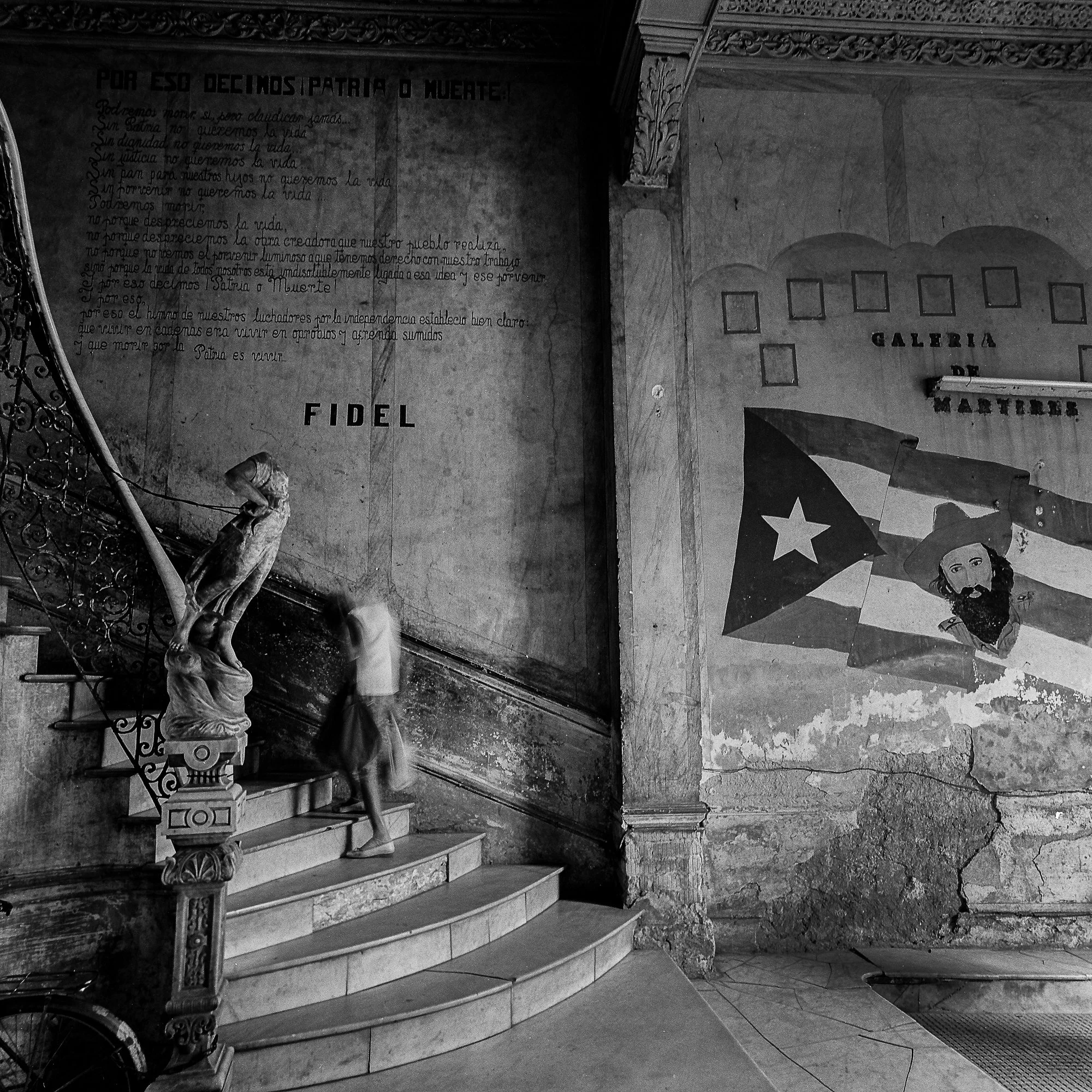
I keep thinking of the woman on the stairs in Havana, because everything in the frame seems to lean toward her, or perhaps dissolve through her.
At the base, a statue of a woman stands without a head, fixed, permanent, already void of identity. Just in front of her, a woman climbs these stairs, but in motion her head disappears as well, blurred out of recognition. One has lost her head to time, the other to movement, and between them the distinction between permanence and presence begins to collapse. It is not that identity is violently taken, it simply fails to register, fails to hold.
The space around them deepens this quiet erasure. To the right, the “Galería de Mártires” offers frames without faces, memory without image. They suggest that someone once filled them, someone worth remembering, but now only the structure of remembrance remains. It is as if memory itself has thinned, still there, but no longer able to appear.
Above it all, the words~“Patria o muerte”~linger on the wall. They haven’t been removed. They haven’t even been altered. But like the worn marble beneath the woman’s feet, they feel softened by time, less an active declaration than a residue. The words remain intact, yet their certainty seems to have faded into the same surface that holds it.
Even the presence of Camilo Cienfuegos, layered into the flag, does not interrupt this feeling. He is still visible, still iconic, but absorbed into the wall~less a figure going forward than one receding into it.
And so everything begins to align:
the headless statue,
the blurred woman,
the empty frames,
the subdued words.
They don’t speak of absence outright. Instead, they suggest a slow, almost imperceptible fading~of faces, of meaning, of clarity. Not erased, not gone, but no longer fully believed in the way they once were.
The woman climbing the stairs becomes the point where all of this unites. She is moving, continuing, but in a way that resists being fixed or defined. Like the statue below her, she exists without a clear face. Like the empty frames, she passes through without leaving an image behind. Like the words above, she is present, but slipping, just slightly, out of alignment with what surrounds her.
In Cuba, the past does not disappear. It lingers in walls, in language, in symbols. But here, it feels as though it is slowly loosening its grip, not breaking away, but softening, fading of what is and what was.
And in that space between what remains and what no longer fully holds, the figure of the woman continues upward, visible, yet already, in some quiet way, beginning to disappear.
