So He Stands
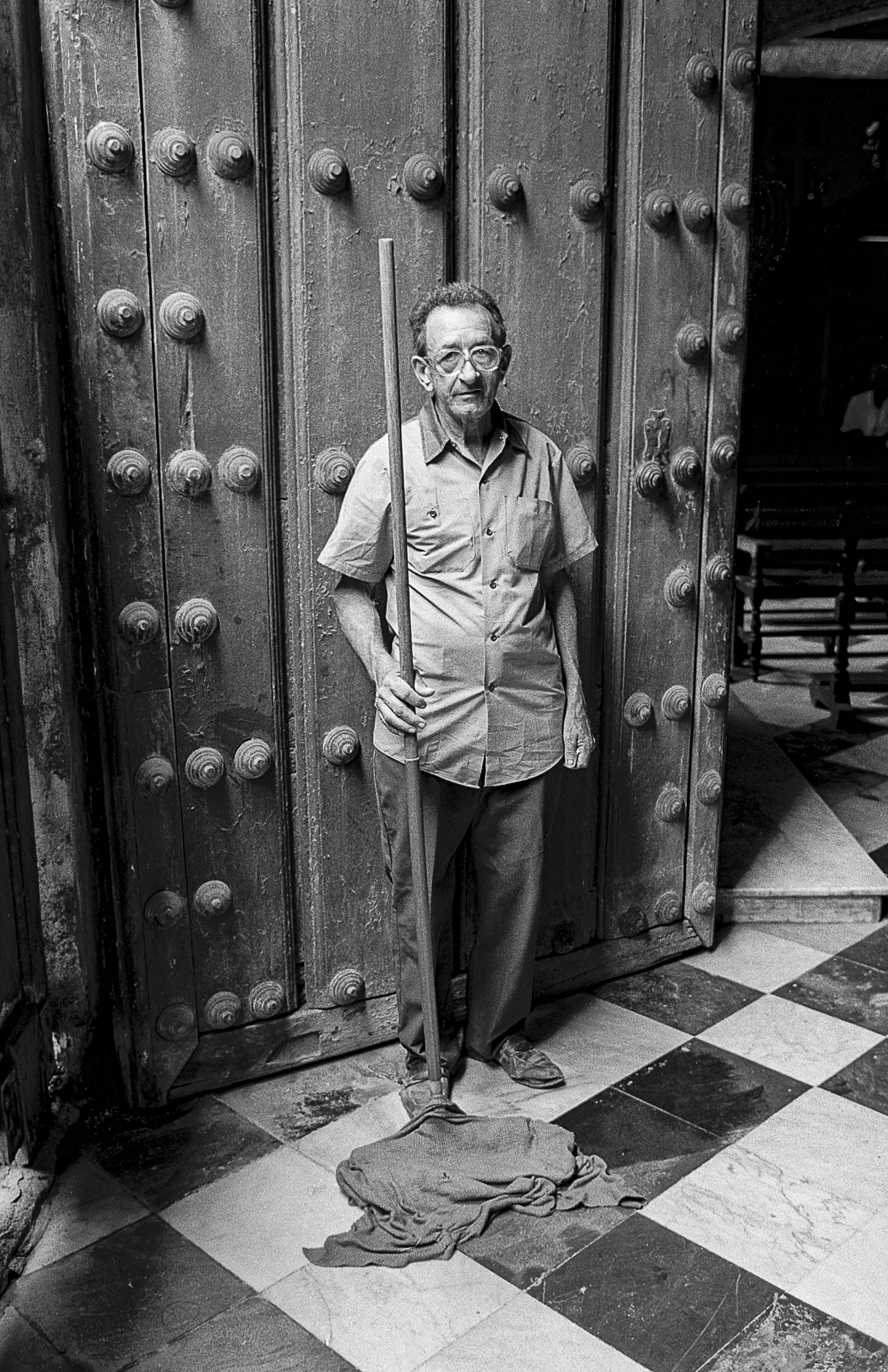
He stands as if he has always been there, as if the door behind him, three centuries of hands, hinges, prayers, had shaped him in its own image. In Havana, or any place that has learned to wait, time doesn’t pass so much as it settles, like dust in the grooves of wood, like water in the threads of a rag.
I remember thinking, when I raised the camera, a kind of quiet witness. Not guarding the church, not exactly serving it either, but existing in that narrow margin where duty becomes habit and habit becomes identity. The mop dragged across stone leans into him like a companion that has outlived its usefulness but refuses to be discarded. It has known as much water as the door has known touch. Both reduced, both enduring.
His face carries no declaration of faith, no visible fervor. If he believes, it is in the way Cubans often believe: without spectacle, without promise of reward. A kind of private negotiation with endurance. Perhaps he once prayed loudly, crossing himself with conviction under a younger sky. Or perhaps the church was simply where work was, and work, steady, modest, necessary became its own form of devotion. In places like this, faith and survival tend to borrow each other’s language.
The door behind him is magnificent in its fatigue. Iron studs pressing outward like small, stubborn declarations. It has kept out storms, intrusions, revolutions, and still it stands, though no one would call it strong anymore. Like him. Like the shoe on his left foot, the sole peeling away, separating slowly from the upper, as if even the act of walking has become too much to hold together. You notice it only after a moment, and once you do, you cannot look away. It is the smallest detail, and yet it says everything.
Inside, just beyond the threshold, the floor turns into a geometry of black and white, order imposed on wear, pattern insisting on meaning. But he remains outside it, positioned in the imperfect light, where things wear away. He does not belong to the symmetry of the interior, nor entirely to the chaos beyond the door. He inhabits that thin, human space in between.
I never asked his name. In Cuba, names often feel beside the point. What matters is presence, the fact of having endured another day, of having held a position, however small, against the erosion of time. He might go home to a room with history, to a chair that remembers his weight, to a meal assembled more from ingenuity than abundance. Or he might stay, lingering after the last footsteps fade, listening to the echo of a place that once believed more firmly in itself.
And yet there is no bitterness in him, at least none that insists on being seen. Only a kind of acceptance that feels older than politics, older even than faith. The understanding that things wear out: doors, shoes, cloth and bodies. And still, each morning, someone must stand here. Someone must hold the line between inside and out, sacred and ordinary, past and whatever remains.
So he stands.
And the door, the shoe, the rag, and the man, each in their own quiet way, tell the same story: not of collapse, but of persistence. Not of belief, but of staying.
