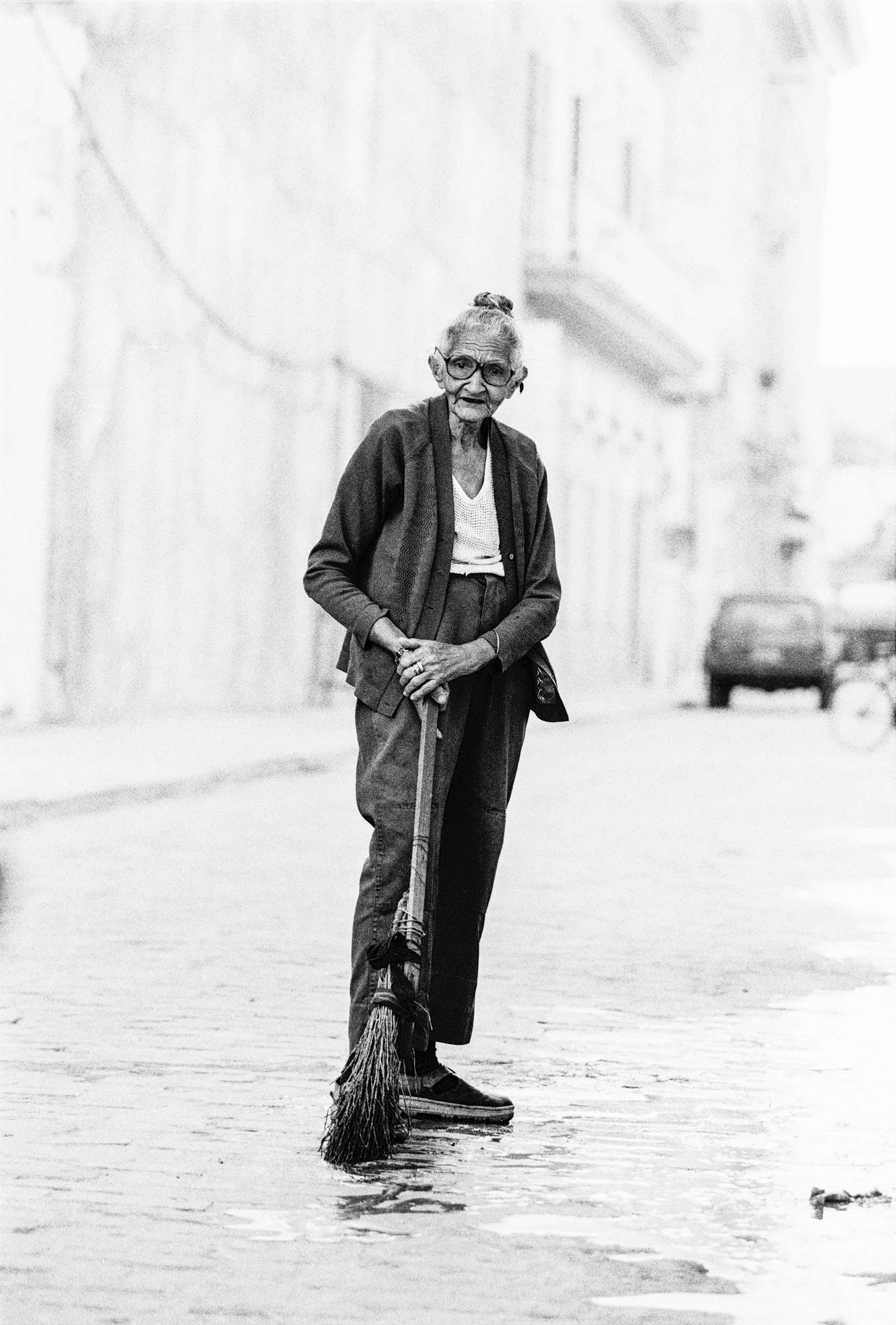
A woman and her broom.
I have spent more than a year of my life in Cuba, returning thirty-nine times over two decades with a camera and an open mind.
I never went looking for poverty. I went looking for Cuba.
I remember this woman standing in the wet street, the rain having passed, holding a broom that seemed to have been fashioned from little more than a stick and the dried remains of a plant.
What struck me was not what she lacked, but what she possessed.
There was dignity in her posture, elegance in the simplicity of the act, and something quietly ingenious about the broom itself. A seemingly ordinary task—clearing the water from the street—became, for a moment, almost graceful.
Then she looked at me.
I pressed the shutter.
Recently, during a Q&A at an exhibition of this work in Colombia, I was angrily accused of photographing Cuba only to show its poverty, to not have shown both sides of the coin so to speak.
But that is not what I saw.
I saw a woman doing something ordinary with extraordinary dignity.
Perhaps that is the difficulty with photographs. We bring our own histories, politics, expectations, and prejudices to them. Two people can stand before the same photograph and see entirely different things.
I cannot control that.
Nor should I.
My responsibility was simpler:
To be there.
To look carefully.
And to photograph honestly what was in front of me.
This woman was not an argument.
She was not a symbol of poverty.
She was simply a woman, standing in the aftermath of rain, holding a broom she had made from what was available, carrying herself with a dignity that needed no explanation.
I saw her.
And I made the photograph.
