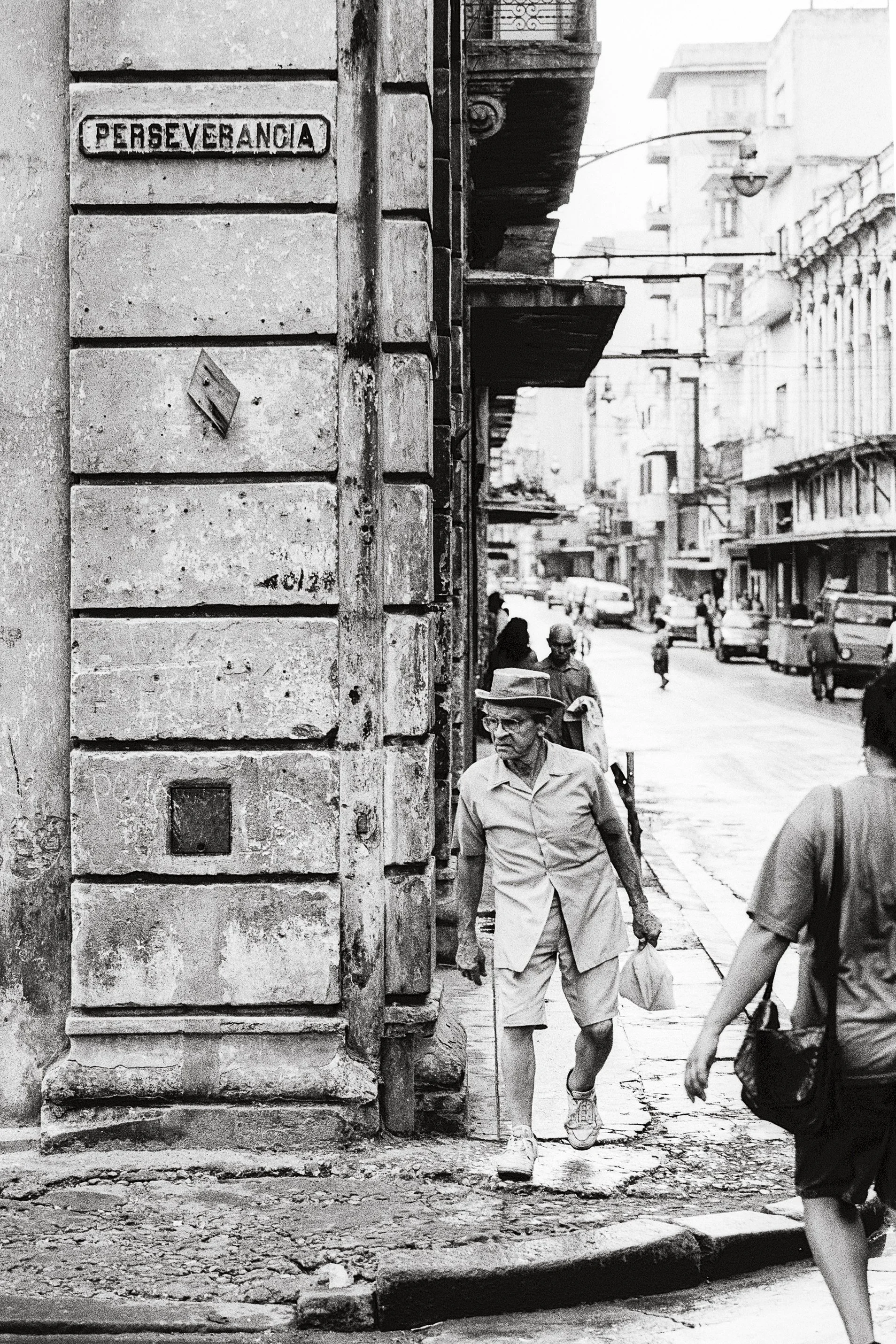
The first thing I wrote in my notebook wasn't about the old man.
It was the street name.
Calle Perseverancia. Old man. Plastic bag.
I looked at that word again.
Perseverancia.
Perseverance.
Havana had a habit of naming its streets after qualities life demanded from the people who lived on them. I wondered if anyone still noticed. After enough years, words become like furniture. You pass them every day without wondering why they're there.
The old man was about to step off the curb just as I lifted the camera.
One hand carried a small plastic bag. It wasn't much. In Havana, it didn't have to be. Proof that the morning hadn't been wasted. In Havana, you learned not to measure success by abundance. Success was coming home with something.
I never found out what was inside.
It didn't matter.
The photograph had already told me everything I thought I needed to know.
There is a peculiar rhythm to deprivation. It doesn't announce itself. It settles in like humidity. After a while people stop speaking about what they don't have and become experts in what can be done without it. Water until the electricity returns. Rice without beans. Coffee without coffee. Birthdays without presents. Conversations without expectations.
Foreigners always asked how Cubans endured.
They asked the wrong question.
Endurance suggests an end.
This had become life.
The street was full of eyes. Conversations paused as I lifted the camera, just as they always did. People looked at me, at each other, at passing cars, at open doorways. They noticed everything except the old man. He belonged there. There was nothing unusual about an old man carrying home whatever the day had given him.
I took the shot and looked for what other moment I could capture. Then I moved on.
That was what I always did.
Another face. Another roll of film. Another street.
I looked back at what I'd written that night.
Calle Perseverancia. Old man. Plastic bag.
Three facts.
Nothing about what I felt.
At the time, I mistook that for objectivity.
That illusion lasted longer than I care to admit.
Years later, while editing old contact sheets, I came across him again.
By then the island had grown quieter.
Not peaceful.
Quieter.
The silence that comes after another power outage when fans stop turning and refrigerators surrender. The silence of elevators frozen between floors. Of mothers wondering whether the chicken would spoil before the lights returned. Of old men who had stopped discussing politics because politics had become as predictable as the blackouts.
The shortages had multiplied, each one giving birth to another. Food disappeared. Fuel disappeared. Medicines disappeared. Young people disappeared. They crossed jungles, borders, oceans, leaving grandparents behind to guard apartments that were slowly falling apart with the city itself.
I stared at the street sign again.
Perseverancia.
When I took the photograph, I thought the word belonged to the Cubans.
Now I'm not so sure.
Perhaps it belonged to the street.
The word on the corner stayed perfectly legible. Everything else seemed to be fading around it.
As for the people...
I no longer like calling them resilient.
Resilience is a compliment the comfortable give to those with no alternative.
No one wakes up hoping to become resilient.
They wake up hoping there will be bread.
Or electricity.
Or aspirin.
Or that their son will call from Miami.
Nothing in his expression suggested he expected any of these things. He was simply carrying his small bag toward wherever home happened to be, as if this day deserved no more attention than any other.
The photograph has changed over the years.
The man hasn't.
When I first came to Cuba, I thought the tragedy was everything people had lost.
Looking at this photograph now, I wonder if the greater tragedy wasn't the shortages or the blackouts, but the way an entire nation learned to fold them into ordinary life.
I looked at my notebook one last time.
Calle Perseverancia. Old man. Plastic bag.
It still reads like three facts.
Only now am I beginning to understand what I was really photographing.
